It’s been a whirlwind month and a half for Gaurav Gupta. Vogue Singapore’s last meeting with the star couturier took place in October last year at the hallmark Next In Vogue, where hundreds gathered to hear him speak about the brand’s trailblazing journey and his vision for the future of fashion. The accolades are endless: to date, the designer and Central Saint Martins alumnus—who celebrates his brand’s 20th anniversary this year—has become renowned for sculptural, architectural, one-of-a-kind designs that blend spiritualism, traditionalism and futurism, all succinctly packaged in an otherworldly armour.
As I catch up with Gupta on a December afternoon, it’s clear that there has yet to be a moment of pause. “There’s so much happening,” he shares with a smile. In this short span of time, following his sweeping success at the 2024 Emmys, as well as outfitting Bollywood star Alia Bhatt in a style-defining Paris Fashion Week moment, Gupta has dressed more heavy hitters—Adele, Karol G, Victoria Monét and Nicola Coughlan—and has found a dedicated supporter in superstar Kelly Rowland, who has worn several of his designs.
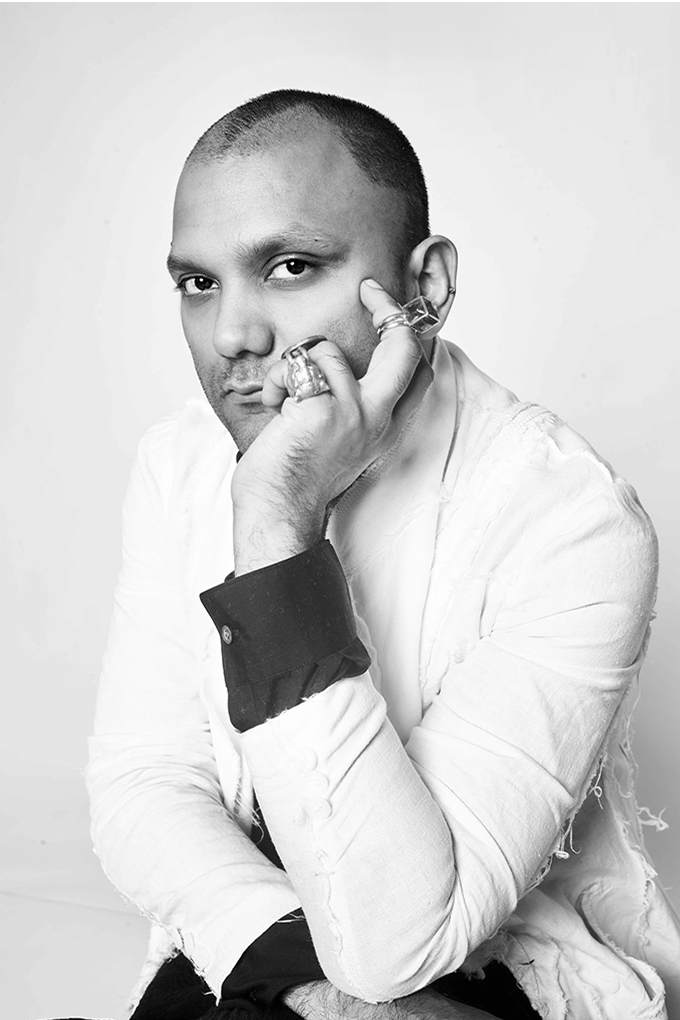
On a personal note, however, Gupta reflects on a particularly special moment that he describes as the biggest win of his life: the discharge of his partner from hospital following a devastating fire accident. Both Gupta and his partner were injured, with the latter in intensive care. In a heartfelt Instagram post marking six months since the event, Gupta expressed gratitude for the outpouring of prayers and support: “Our hearts are full of gratitude for all your prayers and blessings. We want to spread the message that rebirth is possible, to anyone out there who thinks it is not.”
As he marks this chapter—one defined by resilience, bravery and love—Gupta reflects on what 2025 holds for him: his upcoming couture collection this month, the brand’s direction, as well as the power of togetherness and resurgence.
What were some of the most integral moments for you in 2024?
On a personal front, my partner spent two and a half months in the hospital. Publishing that Instagram post, however, felt like a step towards social recovery for us. It’s been a kind of mental recovery too. We want to set an example of what love, resilience and strength can do—how it can be a rebirth for people and for artists. She’s a poet and performer, and I’m a designer, and we want to spread that message. And then there’s the resilience of the brand—me, my brother, my team and our brilliant departments—the way we’ve pulled through everything. Despite everything happening, we’ve managed to achieve so much. Being a mid-sized brand from India, there’s something magical about it—it’s full of emotion and affection, not as cold as people often perceive fashion to be.
Today, the world sees the success of Gaurav Gupta. Was there a defining moment when you realised that fashion was your true calling?
I’ve always been drawn to art—drawing, sculpting or working with clay. My school offered a sculpture module, which ignited my passion. On my maternal side, my family is very religious, with their own temples dedicated to Krishna in Delhi. Spending time in them, surrounded by vibrant colours, mythology and festivities, shaped my sensory world. Spirituality and Indian mythology have always been a part of me. When it came to growing up in India, fashion was an intrinsic part of daily life, no matter where you were. For instance, my mother might wear a bright yellow saree with glittering, royalesque chiffon embroidery, or a printed sari when we travelled to the countryside or the hills—something that might seem unimaginable in other cultures. You’re constantly immersed in a rich tapestry of silhouettes, prints, embroideries and textiles.
Your time in Central Saint Martins was particularly formative. What was the experience like for you?
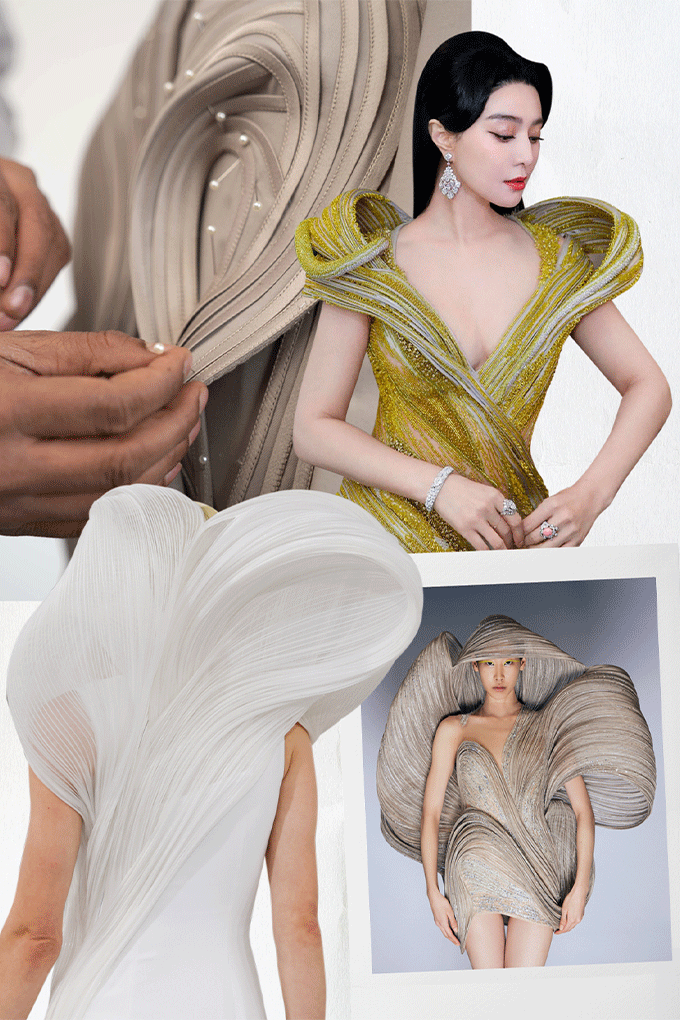
I was making clothes inspired by perspective, pictograms, photograms of Man Ray, and Magritte. I was drawn to esoteric, surrealist, mathematical and conceptual fashion. But when it came to my final collection at Central Saint Martins, I realised that I missed India. I then had my entire room filled with paintings of gods. I was struck by the imagery: a woman riding a tiger, holding a chakra in her hand. It was surrealism, but it was real in our mythology. I wasn’t chosen for the press show and I was devastated. But then, the same collection was invited to Rome Couture Fashion Week, Altaroma Altamoda. The mayor of Rome gave me a trophy for being the future of couture. I was featured in Vogue Italy. It was a turning point. A year or two later, someone pointed out that the six garments represented the elements. I was amazed.
One of my favourite quotes from you is, “The infinity in ancient Indian philosophy is what is Indian about me.” How has this notion influenced how you subverted labels?
When I put pencil to paper, I don’t simply draw a shirt. Instead, I start with abstract forms or shapes. Even when I’m sketching a jacket, I try to subvert it—adding different shoulders or playing with the design. I enjoy experimenting with shapes. Everything I encounter would feel boring otherwise. I appreciate the dichotomies in things, which is why I avoid being defined by categories like ‘modern’, ‘costumesque’, Indian or Western. Those labels don’t matter to me. What fascinates me about India is its openness to fluidity.
How has this played within the realm of traditional wear?
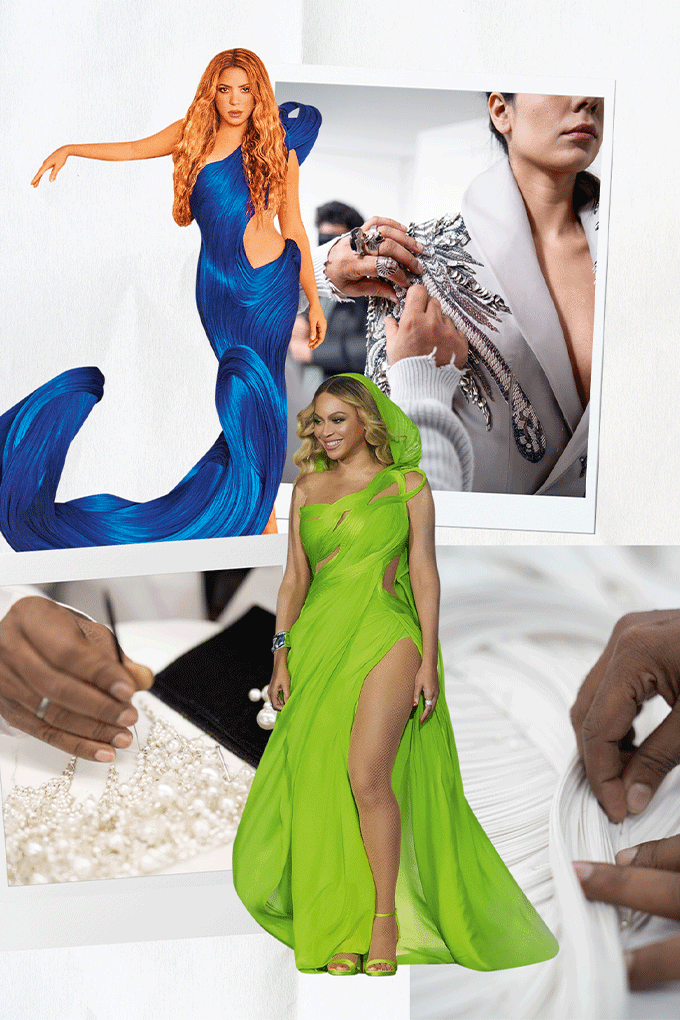
I did my first proper show in India in 2006 and it created a huge buzz. We were doing things like deconstructing jersey fabric, which was considered cheap and associated with hosiery at the time. So, I thought, “Now that I’m back in India, why not experiment with sarees in the next season?” When I looked at a saree, I saw it as a rectangular piece of cloth draped in hundreds of different ways. There was already so much happening with it, so I couldn’t take the conventional route. Instead, I began playing with it—gathering, knotting and pleating it, trying different forms. This led to the creation of the saree gown. For example, we might use a lace bodice and let the saree flow through it or experiment with other creative elements. The saree has survived for thousands of years. For me, it was about celebrating it and bringing my own interpretation to it.
Being invited to join the Fédération de la Haute Couture et de la Mode has been a significant milestone in your journey. What do you think people might not realise about the steps you took to reach this point?
People don’t realise how much work it takes. I had to ensure the brand was both sustainable and profitable. The expense involved is massive—it’s not just financial; it also requires huge investments of time, energy and effort. We’ve built a team of 600 people and developed our systems, faculties and infrastructure. People don’t realise the cultural evolution required to make this happen. I’m trying to explain to a tailor or an embroiderer that we can do something different, while they’ve been doing the same thing for years. It’s about building a new culture. We’re coming from a completely different universe. Fashion as a formal industry in India is only about 30 to 35 years old. There were no fashion shows in India 25 years ago. Fashion was created for kings and nobles.
“I love the anarchy and open-mindedness of fashion, how it celebrates individuality.”
With your couture show coming up this month, tell us about your creative process when it comes to putting a line-up together.
It’s 200 no’s before we say a yes. It’s the pain of months spent finding that right ‘yes’—finding the right voice for even one colour, one shape, the design of a button, how an embroidery would look or how a garment would be cut. What’s challenging is making wearable art. You create art, and then the twist lies in this: if I can make something that shifts the grain but is still wearable, that’s the real challenge.
What do you think the future of couture in Asia looks like now?
People are becoming much more confident in their own style. There’s a new, almost global, Asian style developing. Asia is finally recognising its own talent—brands like us, Robert Wun and even someone like Chet Lo. Asia is realising the financial power it holds. We’re now at the same level as the rest of the world. It’s a true moment of globalisation for Asia, but it retains that local feeling.
With 2025 marking the 20th anniversary of your brand, do you have any special plans to celebrate this milestone?
We’ll be doing something big. We’re looking at the best way to showcase our 20-year journey in different ways. It’s going to be in India, but I think there will also be something in Paris. We’re targeting mid-year when the couture shows are happening.
What are some of your favourite and least favourite things about fashion?
My favourite is sketching—I love creating and reaping the rewards of that. I also love the crazy, passionate people. I love the anarchy and open-mindedness of fashion, how it celebrates individuality. What do I hate about fashion? It’s a lot of work! It’s not as frivolous as people think. It’s subjective and there’s so much more to it. I dislike it when fashion gets homogenised. But the biggest issue, of course, is that fashion is destroying the world. It’s damaging the environment. Also, despite fashion being a space for love and acceptance, it’s often used as a tool of insecurity. That’s something we need to change. People in fashion have so much love, but those insecurities stem from the extreme commercialisation of the industry. With so much money to be made, the commercialisation of it is bringing insecurity and destruction.
What keeps you grounded?
It’s my family and friends. I’m super close to them. And especially with this incident, I’ve realised the power of togetherness and love. It’s been an insane amount of support. It’s love that keeps me grounded.
What does the word ‘resolution’ mean to you?
To me, resolution means discipline. Everything in life is a discipline. A few hundred years ago, classical musicians and dancers had such a connection to this element. For me, a resolution is finding my own rhythm of discipline, which ties into my health, happiness and balance—or rather, the imbalance within that balance.
Vogue Singapore’s January/February ‘Resolution’ issue is now out on newsstands and available online.